
Access to this content requires acceptance of our Data Use & Privacy Policy.
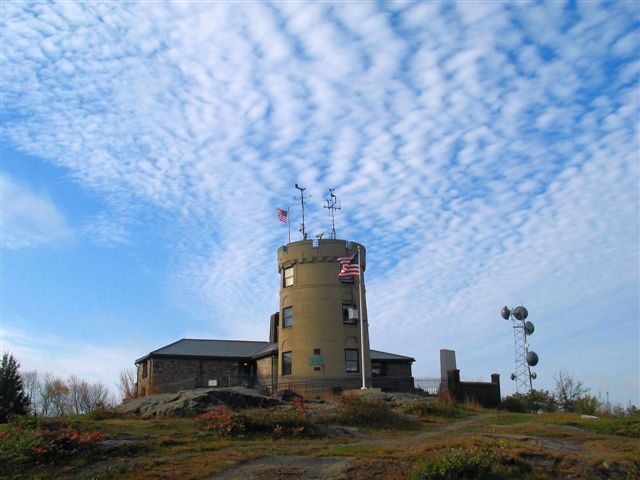 The founding objective of the Blue Hill Meteorological Observatory (BHO) in 1885 was to establish the first private observatory for the measurement of weather and climate at a location that was distinctly elevated above the surrounding terrain and to support special investigations in meteorology. The continual and meticulous recording of temperature, moisture, precipitation, snowfall, wind speed and direction, pressure, clouds, sunshine and many other parameters above the majority of surface obstructions was intended over time to provide a unique perspective of the state of the lower atmosphere and the local weather. Considerable care has been taken to continue the use of traditional instrumentation and observing methods to ensure the highest degree of continuity in the measurements as possible. More than 130 years later, the BHO observations form the longest, most consistent, and most extensive climate record in North America, and they are an irreplaceable resource in support of the BHO mission to advance climate research and public education of atmospheric science.
The location of BHO at the 635-foot summit of Great Blue Hill within the 7000-acre Blue Hills Reservation ten miles south of Boston, Massachusetts has provided a relative degree of isolation from the local urban growth over the last century. The extent to which urban warming in the vicinity of Boston and vegetation changes on Great Blue Hill have affected the Observatory climate data has not been fully established. However, these are only two of the complex and overlapping factors on multiple scales that may influence the temperature and other weather parameters observed at BHO.
Temperature
Among the many parameters recorded at Blue Hill, multiple indicators reflect the changes that have occurred at this location over more than a century, though the surface temperature is among the most prominent. The BHO annual mean temperatures since the middle 19th century are shown in black in Figure 1. All data from February 1, 1885 to the present were observed on the summit of Great Blue Hill. Earlier temperatures from 1831 through January 1885 were observed from two nearby valley locations that overlapped with BHO measurements for several years in the 1880’s, which allowed the valley data to be adjusted to the summit location, and these temperature data are shown for historical context. Most of the upward trend since the 19th century was observed directly on the summit. Centered running mean temperatures are also shown for 10-year (blue) and 30-year (red) periods that smooth the data to illustrate decadal scale changes. A linear fit to the annual temperature data over the period 1885 to 2017 indicates a trend of +0.173 °C/decade with a better than 99.9% confidence that the trend is statistically significant.
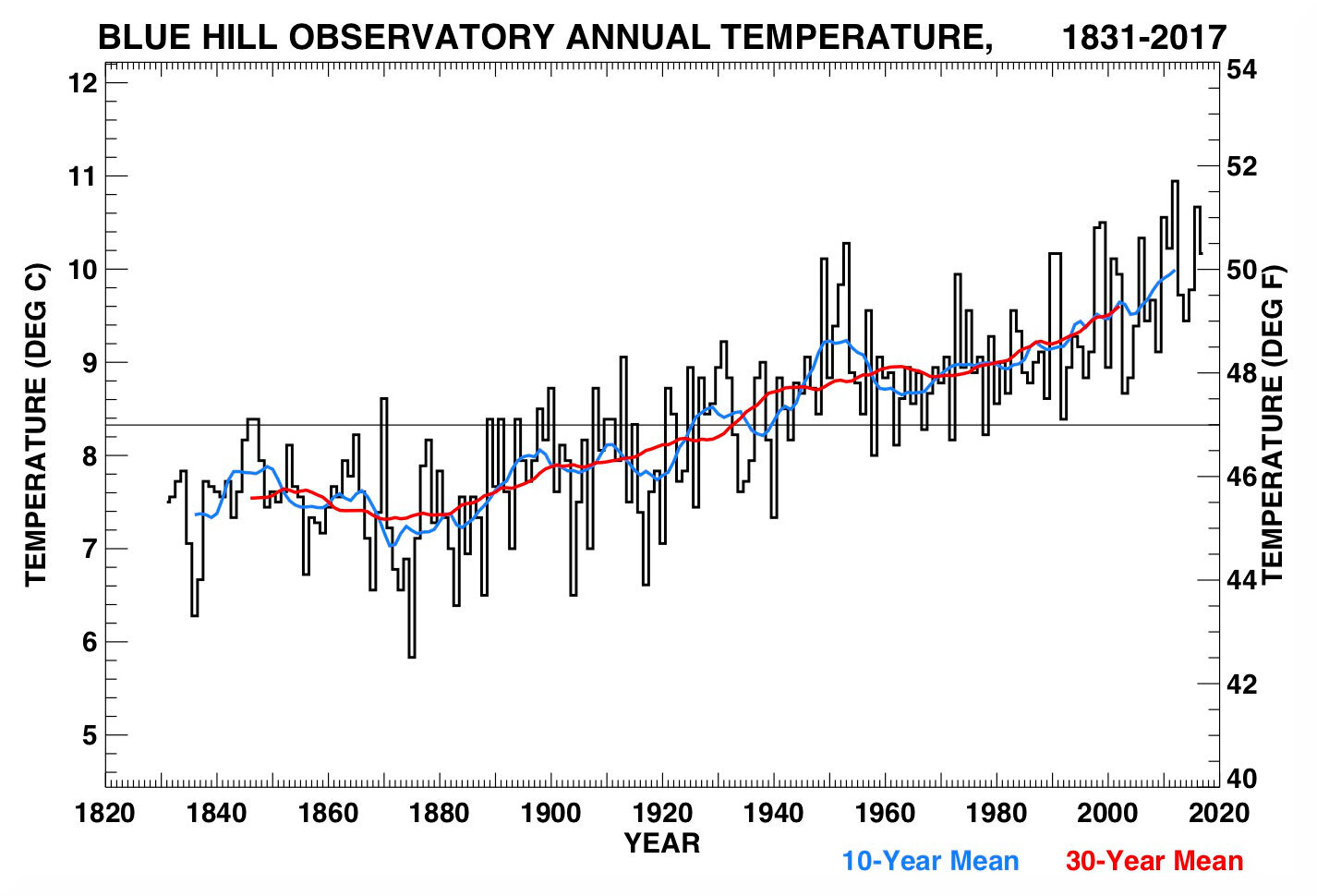 |
| Figure 1. Blue Hill Observatory annual mean temperature (black) from measurements taken on the summit of Great Blue Hill (1885-present) and adjusted to the summit from two nearby surrounding locations (1831-1884). Units are labeled in degrees Celsius and degrees Fahrenheit. Centered running means are also shown for 10-year (blue) and 30-year (red) periods. The straight black line represents the full period average from 1831-2017. |
The most recent BHO 30-year (1988-2017) mean temperature of 9.6 °C (49.3 °F) is the highest on record, and the 30-year running mean has increased by 2.2 °C (4.0 °F) since the late 19th century. Looked at another way, nine of the ten warmest years on record since 1885 have occurred since the early 1990’s including the warmest year, 2012, which averaged 10.9 °C (51.7 °F). The occurrence of extreme temperatures has also shifted in recent decades. Since 1990, there have been 135 new daily high maximum temperature records, while during this time only 20 new daily low minimum temperature records were observed. In addition, ten of the twelve months have been the warmest on record over the last 20 years, while only one month has been the coldest on record over the last 80 years.
A comparison is shown in Figure 2 of BHO temperature trends to those observed at larger spatial scales as 10-year running means for a range of scales from local to global. The mean temperatures in Figure 2 are plotted as differences from the 1901-2000 average for the entire globe and the globe over land areas only, for the United States, for the Northeast Region (New England, New York, New Jersey, Pennsylvania, Delaware, Maryland, and West Virginia), for southern New England (MA, CT and RI) and for Blue Hill.
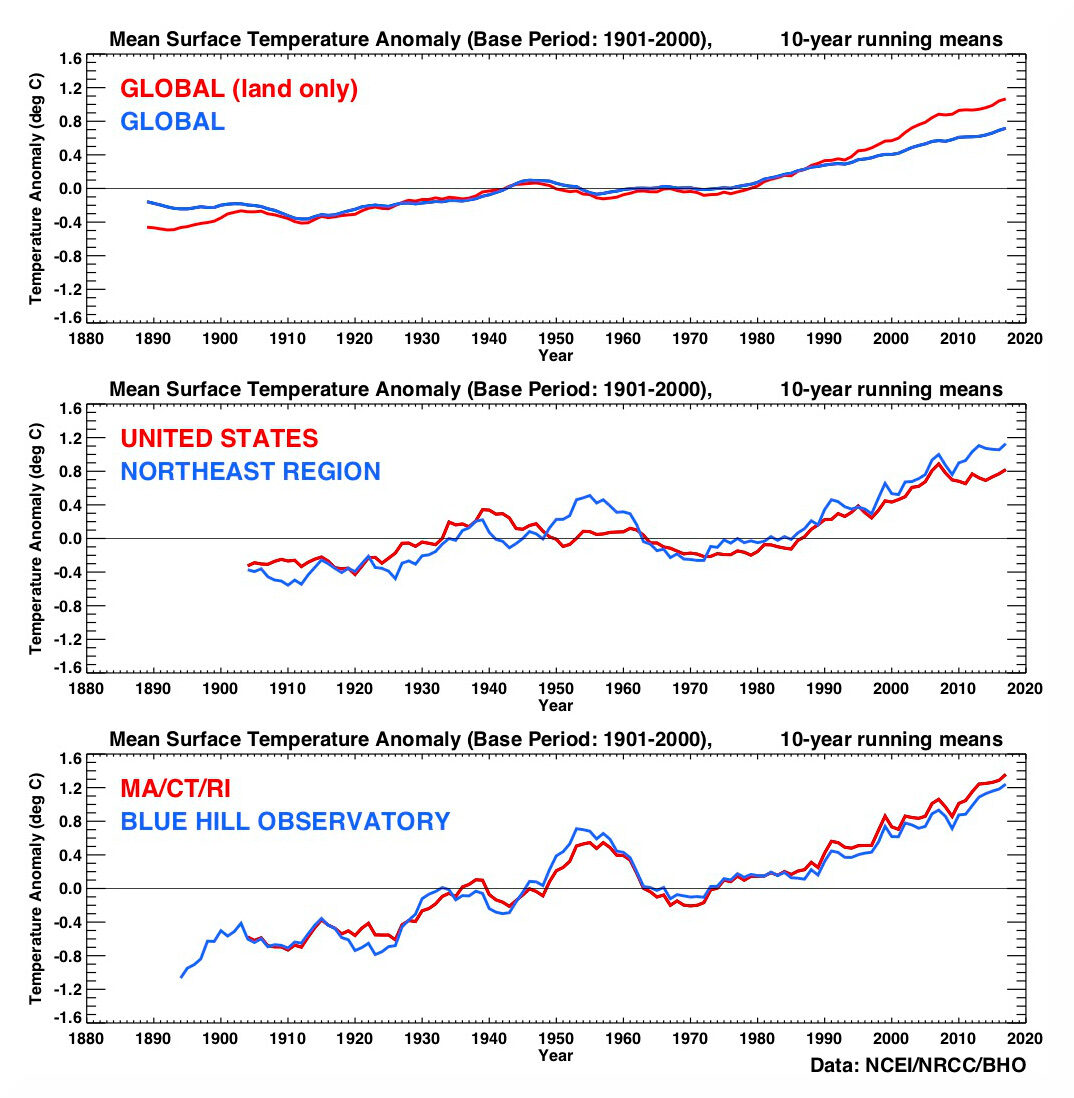 |
| Figure 2. Temperature anomalies relative to 1901-2000 plotted as 10-year running means for multiple spatial scales. Units are in degrees Celsius. Global, national and state temperature data are courtesy of the National Centers for Environmental Information (NCEI) and the Northeast Regional Climate Center (NRCC). |
All mean temperatures in Figure 2 at the national, regional and local scales are derived from the average of the daily maximum and minimum temperatures. At the global scale, the temperature has increased by about 1.2 °C (2.2 °F) since 1880, or about +0.092 °C/decade (for the period 1880 to 2012 as stated in the Fifth Assessment Report of the Intergovernmental Panel on Climate Change). Slightly larger increases are seen over global land areas only relative to the entire globe. At the local scales, larger temperature rises have been observed over this time with more inter-decadal variability than at the global scale. While increases during the 1930’s were observed at all scales, a period of warmer temperature in the 1950’s was more pronounced on local scales. Since 1980, a steady rise in temperature with short interruptions has been observed at all scales.
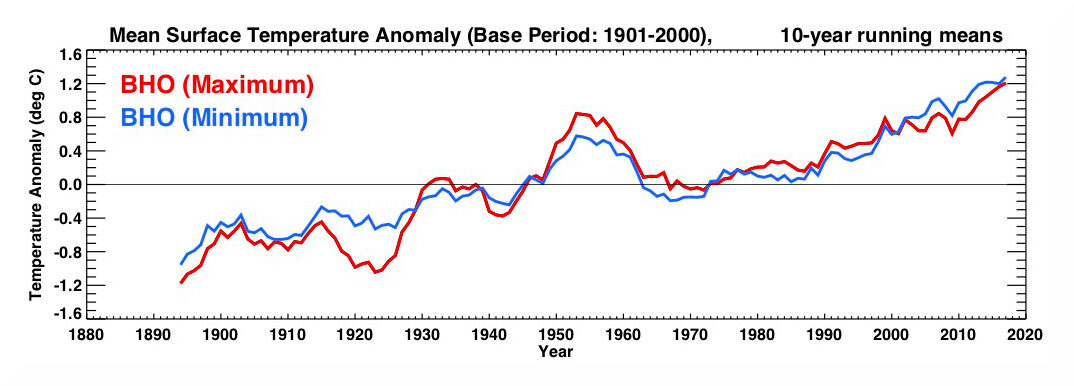 |
| Figure 3. Temperature anomalies for the Blue Hill Observatory relative to 1901-2000 plotted as 10-year running means for average daily maximum (red) and daily minimum (blue) temperature. Units are in degrees Celsius. |
Examining the relative changes in the average daily maximum and daily minimum temperatures over a long period can provide additional insight on temperature variations. Figure 3 shows the 10-year running means of the annual average BHO daily maximum (red) and daily minimum (blue) temperature plotted as differences from their 1901-2000 means. Although the increases over the whole period of record are similar for each parameter (in excess of 2.0 °C), the average minimum temperature shows a slightly larger increase since the middle 20th century than the average maximum. In addition, maximum temperature shows larger decadal variations compared to minimum temperature, in particular during the 1920’s and 1950’s.
The science community has attributed the recent rise in global temperature to human activity with a great deal of certainty, and this “greenhouse warming” due to increasing carbon dioxide from the burning of fossil fuels is consequently a contributing factor in ongoing temperature changes at BHO. However, the specific causes of the much larger regional increase in temperature observed at Blue Hill remain under investigation. The goal of the BHO climate record is to continue to provide a reliable, accurate and invaluable historical context in which to improve our understanding of Earth’s climate.
Precipitation/Snowfall
The highly disruptive effects of flooding events and winter snowstorms make rainfall and snowfall among the most impactful aspects of the weather, so it is especially important that changes in precipitation means and extremes be carefully monitored and investigated to improve our predictive capabilities. At Blue Hill, annual precipitation, which includes rainfall and the liquid equivalent of all frozen precipitation (snow, sleet, etc.), has shown a gradual increase in recent decades. The 30-year running mean precipitation reached a high of 137.4 cm (54.09 inches) in the last decade, which is about 15 cm (5.95 inches), or roughly 12 percent, higher than the 1901-2000 mean. Figure 4 shows the BHO annual precipitation anomalies (green) relative to the 1901-2000 average plotted as a 10-year running mean. Several decadal swings and a slight upward trend are apparent. A linear fit to the annual precipitation over the period 1886 to 2017 indicates a trend of +1.53 cm/decade with a better than 99.9% confidence that the trend is statistically significant. In terms of extremes, six of the ten wettest years at BHO have occurred since 1990 including 1998, the wettest year, with 180.3 cm (71.00 inches), and nine of the ten wettest years have occurred since 1970.
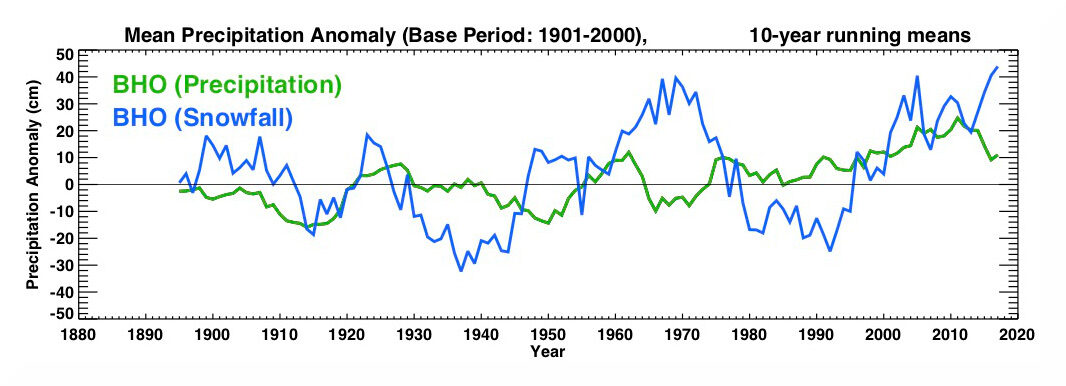 |
| Figure 4. Precipitation anomalies for the Blue Hill Observatory relative to 1901-2000 plotted as 10-year running means for total annual precipitation, which includes rainfall and melted snowfall (green) and for annual snowfall, which includes all frozen precipitation (blue). Units are in cm. |
Annual (Jan-Dec) snowfall over the BHO period of record has averaged 157.5 cm (62.0 inches), and large decadal variations have been observed. Figure 4 also shows the BHO annual snowfall (blue) as differences from the 1901-2000 average plotted as 10-year running means. Very apparent is the cyclical nature of snowfall over the past century with elevated periods of snowfall in the 1960’s to 1970’s and in recent decades, while periods of lower snowfall occurred during the 1930’s to 1940’s and during the 1980’s to early 1990’s. Although annual snowfall does show a linear increase of +2.28 cm/decade since 1886, this trend is not statistically significant due in part to the large year-to-year variations.
Multiple measures of precipitation extremes are noticeably shifting. The mean number of precipitation events of 2.5 cm (one-inch) or more each year has increased from 14 in the mid-20th century to 16 in recent years. In addition, five months of the year have set new precipitation records since 1990. From 1885 to 1990, 12 seasons exceeded 228 cm (90 inches) of snowfall; since 1990, nine seasons have exceeded this amount, including 2014-2015, the snowiest season on record, with 383.0 cm (150.8 inches) and 1995-1996, the previous record season, with 366.8 cm (144.4 inches). Seven of the ten largest snowstorms at BHO have occurred since 1990, and all ten have occurred since 1960.
Wind Speed
One of the most dramatic changes in any climate parameter measured at Blue Hill is the steady drop in the annual mean wind speed in recent decades as shown in Figure 5. A slow decline in the 10-year mean annual wind speed (blue) that began in the 1940’s became a sharper, steady drop after 1980, falling 17 percent from 6.7 m/s (15.0 mph) in that year to 5.6 m/s (12.5 mph) recently, though the decrease has begun to level off in the last few years. The cause of the decline remains under investigation, though it may be related to the shifting of mid-latitude storm tracks, and their higher winds, to higher latitudes. This so-called stilling is consistent with wind speed changes at other locations across North America and Europe.
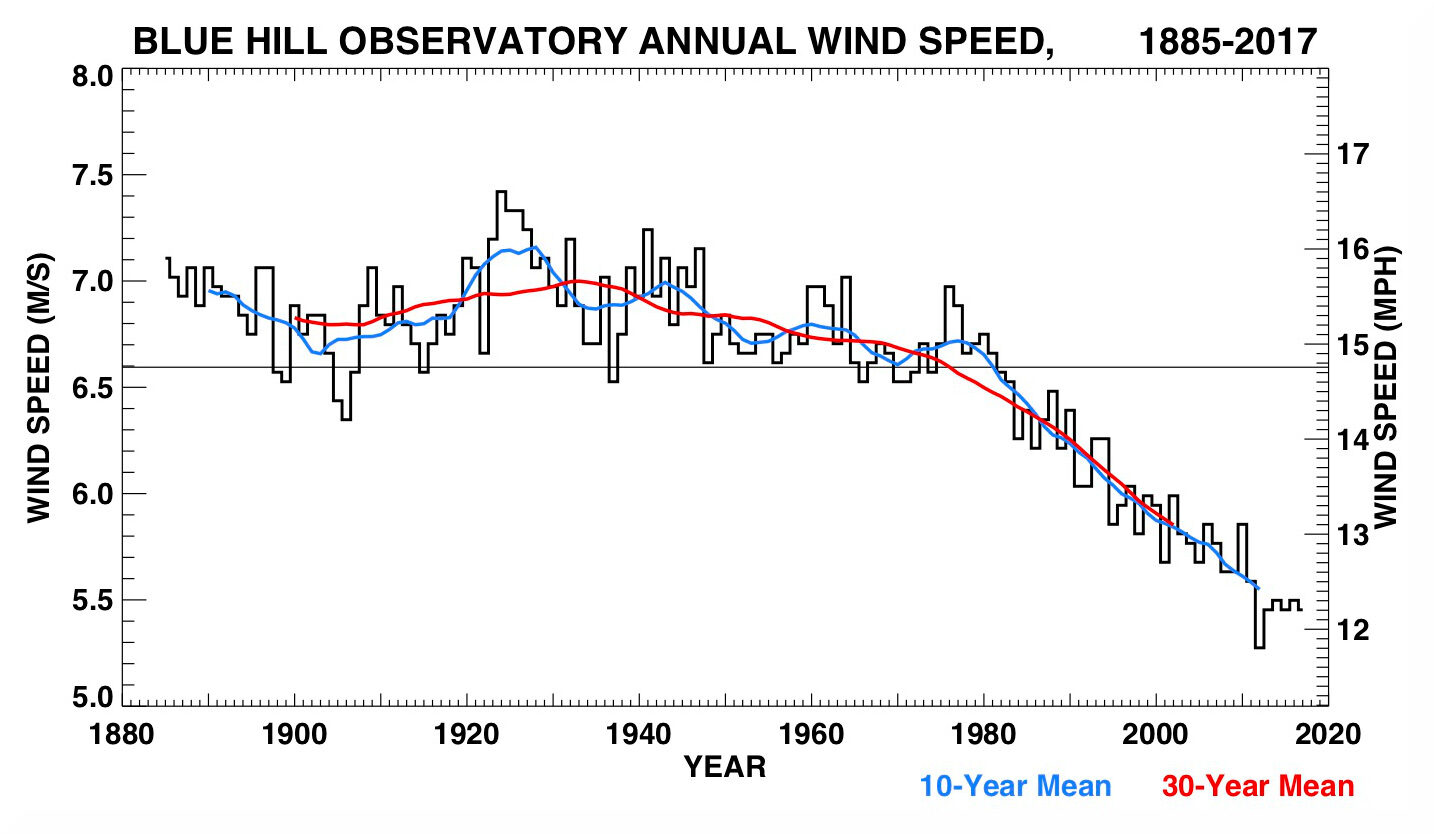 |
| Figure 5. Annual mean wind speed as measured at the Blue Hill Observatory (black) and plotted as 10-year (blue) and 30-year (red) running means. The straight black line is the full period average. |
Finally, local climate changes are apparent in natural processes that are unrelated to weather instruments. Phenology is the study of cyclical changes in plant and animal life, especially in relation to climate. Wild blueberries have grown on the summit of Great Blue Hill since before the founding of the Observatory, and the date of the first ripe blueberry has been recorded every spring. Since 1900, the 30-year mean date has shifted earlier by about one week reflecting warmer spring mean temperatures. Another natural process observed from BHO is the date of the first freeze and last thaw of two local ponds during winter. The increase of winter mean temperatures has gradually reduced the average time that Houghton’s Pond (about one mile east of BHO) remains frozen during winter from 110 days around 1900 to 85 days in recent years, a decrease of more than three weeks. In addition, occurrences of this pond thawing and refreezing during winter are becoming more common.
The long duration of the Blue Hill climate record provides an essential context in which to study climate changes, since several decades of continuous, accurate data are necessary to establish the significance of trends relative to short-term variability. Maintaining the extensive BHO climate record into the future and using it to inform the public about atmospheric science are critically important objectives of the Blue Hill Observatory Science Center that will help ensure that this irreplaceable scientific and educational resource will continue to provide an invaluable historical perspective on ongoing, long-term, local climate changes.


